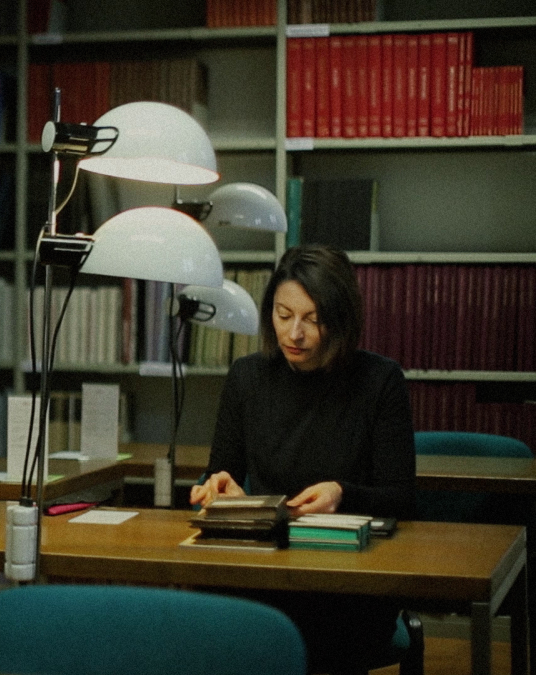
Ana Hofman is an ethnomusicologist and anthropologist whose work explores the intersections of music, sound, and politics in socialist and post-socialist societies. Her research focuses on memory, affect, and activism, as well as on questions of labour, class, gender, political economy, and social movements as they intersect with musical and sonic practices.
She has published three monographs: Staging Socialist Femininity: Gender Politics and Folklore Performances in Serbia (Brill, 2011), Music, Affect, Politics: New Lives of Partisan Songs in Slovenia (ZRC 2015), translated into Serbian as New Lives of Partisan Songs (Biblioteka XX vek, 2016) and Socialism Now: Singing Activism after Yugoslavia (Oxford University Press, 2025).
In 2018 she received the Danubius Mid-Career Award by the Austrian Ministry of Education, Science and Research and the Institute for Central Europe and Danube Region. Beyond academia, she has contributed to equal opportunity policy work in Slovenian research institutions, collaborated with activist initiatives across the region, and worked in documentary filmmaking; she appears in and co-wrote the documentary Solčence zahaja (2020), trailer.
She is an Associate Professor at the ZRC SAZU Postgraduate School (Ljubljana). Her recent visiting appointments include Visiting Fellow, Department of Music, King’s College London (Autumn 2025); Fulbright Postdoctoral Fellow, The Graduate Center, City University of New York (2018); and Visiting Lecturer, University of Music and Performing Arts Graz, Austria (Winter semester 2017). She has also held visiting fellowships and research positions at the School of Music, Federal University of Rio de Janeiro (Brazil); the Centre for Southeastern European Studies, University of Graz (Austria); the Russian, East European, and Eurasian Center, University of Illinois Urbana–Champaign (USA); New Europe College (Bucharest, Romania); the Max Planck Institute for Social Anthropology (Halle, Germany); and the Department of Music, University of Chicago (USA).

Books
Book editor
Special Issues of Journals Edited
Articles in Journals
Book chapters
Ana Hofman’s research over the past two decades has traced how politics becomes audible—how collective singing becomes a form of sociopolitical engagement Through long-term, participant-observer involvement with activist singing collectives across the post-Yugoslav region, she has followed how self-organized choirs revive and reinvent repertoires of partisan, revolutionary, and workers’ songs alongside contemporary socially engaged pieces, treating collective singing as a mode of collaboration and political experimentation. This trajectory culminates in the book Socialism Now: Singing Activism after Yugoslavia (Oxford University Press, 2025), where she traces how socialist ideas and lived experiences are being recuperated in the present. She develops the concept of strategic amateurism to grasp how collective singing can organize against the adverse effects of neoliberal capitalism without collapsing into flattened narratives of “music for social change.”
Her current project turns to (post)socialist everyday musical activities, with a particular emphasis on musical amateurism, leisure, and the forms of spatial and temporal dispossession that followed the end of socialism and introduction of neoliberal capitalism. She examines how reorganized labor regimes and the dissolution of previously public cultural infrastructure reconfigure where, when, and with whom music happens—what kinds of time become available, which spaces become (in)accessible, and what forms of sociality are sustained or foreclosed. Moving between ethnographic and archival research, she examines workplace musical sociabilities—particularly musical railway societies—and the ways they have dissolved, transformed, or persisted within the shifting political economies of the post-socialist world.
Project leader:
Project team member:
Ana Hofman has delivered numerous invited lectures and keynote addresses at universities, research centres, and major scholarly gatherings across Europe, North America, and Latin America. Her talks have been featured at institutions such as Unversity of Chicago, King’s College London, SOAS University of London, the University of Music and Performing Arts Vienna, McGill University, the University of Pittsburgh, the Federal University of Rio de Janeiro, and the University of Hildesheim, among others. She has been a keynote speaker at international conferences and national symposia, addressing themes at the intersection of music, sound, political struggle and affective politics in socialist and postsocialist societies. Her lectures engage questions of musical labor, activism and memory, antifascism, commodification, and the political life of sound, positioning ethnomusicology as a field attentive to both historical remembrance and future-oriented forms of collective imagination.
Lecture in the series “Musical Worlds of Socialist Yugoslavia” (in Slovenian), organized by the Slovenian Musicological Society in collaboration with the Institute of Ethnomusicology ZRC SAZU.
Title: “Between ‘Shifts’: Musical Life in Yugoslavia between Work and Leisure” (in Slovenian)
Keynote at the celebration of the 60th anniversary of the Department for Ethnomusicology, University of Music and Performing Arts, Vienna, 2025
Title: “Ethnomusicology between Past Remembrance and Future Making, 80 Years After”
Music and Minorities Research Centre (MMRC), University of Music and Performing Arts,Vienna, annual keynote lecture for 2024 Title: “Between Cultural Labor and Political Struggle: Music and Class.”
Culture&Capitalism Seminar, SOAS, University College London, 2022. Title: “Aesthetic solidarities in a devastating world : the im/possibilities of communal forms of life after socialism”
Lecture at Music Department, King’s College London, 2025.
Title: “Strategic Amateurism: Self-Organized Choirs and the Legacies of Socialist Cultural Commons"
Keynote at the Finnish national symposium of music scholars, 2024.
Title: “Music Activism in a Devastating World Sounds of political survival or survival of the political sounds?
Keynote at the Summer Academy of University of Music and Performing Arts Vienna, Reichenau, 2023.
Title: “Musical Leisure: Sonic Ties against Commodification and Exploitative Forms of Life”
Keynote at the international conference Music and antifascism: reflections on the past and possibilities in the present", McGill University, 2022.
Title: “Is antifascism enough? Singing and listening to contested histories and possible futures.”
Keynote at International conference, Loud memories, turbo folks: mapping of the sounds, images and memories in the post Yugoslav space, 2021.
Title: “Sound, affect, memory: re-listening to the past.”
Keynote lecture at the event “Balkan music and culture: sounds of past and present,” University of Pittsburgh, Department of Music in Carnegie Mellon University School of Music, Pittsburgh, 2018.
Title: “Kafana musicians: music labour in Southeastern Europe between stigmatization and glorification”
Keynote lecture at the Center for World Music (CWM) at the Ninth International Doctoral Workshop in Ethnomusicology, University of Hildesheim & Hanover University of Music, Drama and Media, 2017.
Title: “Sonic regimes of uncertainty : toward affective politics of (self)emancipatory musical alliances”
Lecture at the Music Department, the Federal University of Rio de Janeiro, 2016.
Title: “Música nos Bálcãs : o branding e suas implicações políticas (Balkan music : problematizing politics of branding”
Ana Hofman regularly gives interviews, appears in podcasts, TV and print media across the post-Yugoslav region and beyond. Her work has been featured in major newspapers and cultural magazines such as El País, Jutarnji list, Vreme, Politika, Dnevnik, and Slovenske novice, as well as on platforms including Eurozine, Balkan Insight, Peščanik, Mašina, and P-portal, where she addresses questions of music, memory, nationalism, antifascism, gender, and political mobilization. She has appeared on national television and radio (RTV Slovenia, RTS) and in international podcasts such as Remembering Yugoslavia, bringing scholarly perspectives on partisan song, activist choirs, and cultural politics into broader public circulation. Her media presence reflects a sustained engagement with contemporary debates on music, sound and politics, value, and collective identity in times of political polarization. In addition to interviews and commentary, she is also active in documentary filmmaking and is the author of the documentary film Solčence zahaja, further extending her research into visual and public formats.
Interview by Saša Vesić “Moj Niš”. TV Belle Amie, 2025.
Participation in the documentary film War and Song (Rat i pesma). Radio Television of Serbia (RTS), Official Channel, 2025.
Interview for the television programme Tednik (TV Slovenia), titled “Long Live the Partisan Song!,” 2024.
Interview on Radiotelevision of Slovenia (RTV Slovenia), programme Na glas, hosted by Saša Banjanac-Ljubej, 2024.
Participation in a roundtable discussion at the exhibition opening and comic book launch of the second volume of The Cry of the People (Jacques Tardi), addressing representations of revolt in comics, music, and film, 2022.
Interview at the Podgorica Book Fair (Montenegro), discussing music, politics, and contemporary activism, 2022.
Trailer of the documentary film “Solčence zahaja,” 2020.
Appearance in the talk show about the documentary movie “Solčence zahaja”, Tv Prva, 2019.
Appearance at the show “15 minutes,” Južne vesti TV, 2019.
About documentary "Solčence zahaja":
Promotion of the book “Science with(out) Youth,” 2017.
Participation in the thematic event “Gender Equality in Science? Early-Career Women Researchers” the GARCIA project, promotion of the book, 2017.
Presentation at the international conference Nostalgia on the Move, with the talk “Politics of Sentimentality: Towards an Affectivity of Post-Socialism,” in a panel on nostalgia and articulated resistance, 2017.
Promotion of the book “New lives of partisan songs”/ Novi život partizanskih pesama (in Serbocroatian), Centre for Cultural Decontamination, Belgrade, 2016.
“Toby Miller Podcasts”: A conversation about Serbian protests, socialism, cultural politics, affect, ethnomusicology, Yugoslavia, and leisure/amateurism, 2025.
Interview about the phenomenon of Bella ciao. Radio Rojc, Pula, 2021.
Guest on Glasovi svetov (Radio Slovenia, ARS), in conversation with Martina Tita Mayer, discussing gender inequality in academia and structural barriers facing women researchers.”The Position of Women in Science” (Položaj žensk v znanosti), 2021.
Interview on Radio Akustika Niš by Nataša Tasić, exploring activist choirs and the political potential of radical amateurism in contemporary musical practice. “Choirs and Radical Amateurism,” 2020.
Guest on the programme Frekvenca X (Val 202, RTV Slovenia), discussing urban soundscapes and the social meanings of city sounds. “All the Sounds of Our City” (Vsi zvoki našega mesta), 2017.
Interview on Radio Študent (Kontrola leta), reflecting on partisan songs and their contemporary political and cultural resonances.“Ay, Carmela,” 2016.
Commentator on Slovenska zemlja v pesmi in besedi (Radio Slovenia), addressing Slovenian musical heritage and collective memory. RTV Slovenija, 2016.
Guest at Stepenik (Radio Belgrade 2, Radio Television of Serbia), examining political culture and its sonic and cultural dimensions.“On the Phenomena of Political Culture” (O fenomenima političke kulture), 2016.
Appearance on the programme Frekvenca X (Val 202, Radio Slovenia), in conversation with Saša Vipotnik and Adriana Barton, discussing the cultural and social implications of “switching off” in contemporary life, 2023.
Podcast ARS, Radio Slovenia discussing the book “Music, Politics, Affect: The New Life of Partisan Songs in Slovenia,” 2015.
Audio interview about the book “Music, Affect, Politics” (Telstar / Radio Slovenia), featuring collective and community music practice and discussion, interview by Jure Longyka, 2015.
Ethnomusicologist Ana Hofman: “Collective raising of voices is one of the synonyms for protest.” Interview by Ivana Ljubinković, Portal ClassicAll, 2025.

Etnomuzikološkinja Ana Hofman : kolektivno dizanje glasa je jedan od sinonima za protest.
Ana Hofman: A conversation with the ethnomusicologist and anthropologist. Nenad Rizvanović, Jutarnji list, 31 May 2025.

Ana Hofman : razgovor s etnomuzikologinjom i antropologinjom.
Interview in magazine Vreme by Sonja Ćirić, “Padaj silo i nepravdo” is a Hit Again. 2024.

Intervju: Ana Hofman, Padaj silo i nepravdo je opet hit
Interview on P-portal “Activist Choirs Have Breathed New Life into Partisan Songs” (Aktivistički horovi su partizanskim pesmama udahnuli novi život), 2023.

Ana Hofman: Aktivistički horovi su partizanskim pesmama udahnuli novi život
Interview in Dnevnik Online “On a Slovenian Folk Song That Slovenians Do Not Know” (O slovenski ljudski, ki je Slovenci ne poznamo) – discussing overlooked song traditions and the transnational circulation of so-called “Slovenian” folk music, 2023.

Intervju Ana Hofman, etnomuzikologinja in antropologinja: O slovenski ljudski, ki je Slovenci ne poznamo
An Interview by Antonio Pita for El Pais digital: “l rock casi salva a Yugoslavia,” 2021.

El rock casi salva a Yugoslavia
Interview in Slovenske novice “Partisan Song on the UNESCO List?” (Partizanska pesem na Unescovem seznamu?) – examining debates on cultural heritage recognition and the contemporary status of Partisan song traditions, 2018.”

Partizanska pesem na Unescovem seznamu?
Interview in MMC RTV SLO “Gender Equality: Professors Choose Women Assistants and Male Successors” (Enakost med spoloma: profesorji izbirajo ženske asistentke in moške naslednike) – addressing structural gender inequalities in academia and research institutions, 2017.

Enakost med spoloma: "Profesorji izbirajo ženske asistentke in moške naslednike"
Interview with Ana Hofman for the Remembering Yugoslavia podcast, exploring her research on the revival, meaning, and political resonance of partisan songs in the contemporary Balkans, 2016.

"Novi život partizanskih pesama"
About the book “New Lives of Partisan Songs,” Peščanik, 2016.

"Novi život partizanskih pesama"
Interview for Balkan insight “Old Partisan Songs Have ‘New Revolutionary Potential’,” 2016.

Old Partisan Songs Have ‘New Revolutionary Potential’
Interview for magazine Politika “Ponovo pevamo partizanske pesme” (We sing again partisan songs), 2016.

Ponovo pevamo partizanske pesme
Interview for portal Mašina “Horsko pevanje je važan način kolektivne mobilizacije” (Collective singing is an importnat way of collective mobilization)” 2016.

Horsko pevanje je važan način kolektivne mobilizacije
Profile and interview on Eurozine, in which Ana Hofman discusses the intersections of music, politics, and academic life, reflecting on neoliberal pressures in the academy and the cultural politics of sound and collective practice, 2016.

Neoliberalism and higher education in Central Europe
Interview in Oštra Nula “The New Life of Partisan Songs” (Novo življenje partizanskih pjesama) – on activist choirs and the afterlives of socialist musical repertoires, 2015.

Multimedijalno predavanje “Novo življenje partizanskih pjesama”
Interview with Saša Banjanac Ljubej, Radio-television of Slovenia, 2015.
Lepa Brena: Od "kafanske" pevke do oblikovalke glasbenih trendov na Balkanu”
Interview in Kulturistra “Ana Hofman – The New Life of Partisan Songs in Slovenia” (Ana Hofman – novi život partizanskih pjesama u Sloveniji) – addressing the revival and political meanings of Partisan songs in Slovenia, 2015.

Razgovor: Ana Hofman – Novi život partizanskih pjesama u Sloveniji
Interview in Nova muska “5ka – Thinking Music (with Ana Hofman)” (5ka – Misliti musko) – discussing critical approaches to music, politics, and sound, 2013.

5ka – MISLITI MUSKO (XXX)
+386 1 47 06 528
ana.hofman@zrc-sazu.si
Institutional website:
https://ikss.zrc-sazu.si/en/sodelavci/ana-hofman-en
Academia.edu profile:
https://zrc-sazu.academia.edu/AnaHofman
Google Scholar profile:
https://scholar.google.com/citations?hl=sl&user=8Hw7lCcAAAAJ
Research Gate profile: